Jabal al-Nour & Hira
The mountain above Makkah where the first verses of the Qur’an were revealed. The climb takes about an hour.
Iqra — the first word.
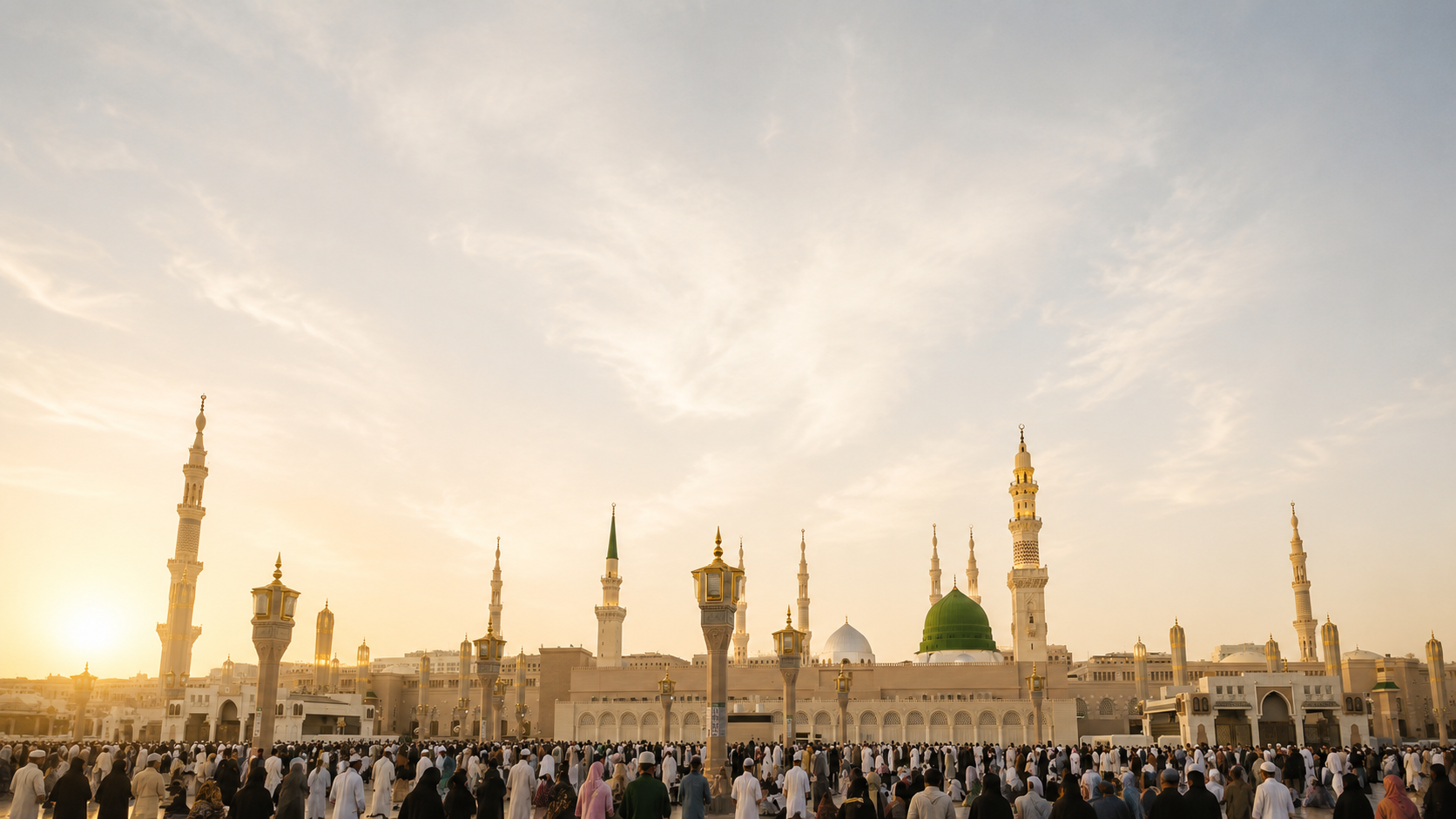
Our most-chosen journey
Twenty-three years of revelation, from a cave above Makkah to a room beside the Prophet’s Mosque ﷺ. Walk it in order, with a scholar telling each chapter on the ground it belongs to.
“Indeed, in the Messenger of Allah you have an excellent example.”
Surah al-Ahzab, 33:21
Most of us learned the Seerah from books and khutbahs. On this journey, the valley of Badr, the slope of Uhud and the path of the Hijrah become places you have stood in — so the next time you hear the story, you can see it.
The prophetic life ﷺ
Fifty-three years in Makkah: an orphan known as al-Amin, the first revelation at forty, and thirteen years of calling to Allah through boycott and loss.
Muhammad ﷺ is born in Makkah to Aminah, months after his father Abdullah has died. Abrahah’s army, marching with elephants to destroy the Kaaba, is turned back the same year.
Known in Makkah as al-Amin, the trustworthy, he marries Khadijah bint Khuwaylid. She becomes the first to believe in him and his greatest support.
At forty, while retreating in the Cave of Hira, Jibreel comes to him with the first words of the Qur’an: “Read, in the name of your Lord who created.”
You stand hereHe climbs Safa and calls the clans of Quraysh to Allah. Persecution follows — Bilal on the hot sands, the family of Yasir martyred.
You stand hereKhadijah and his uncle Abu Talib pass away within months of each other. He walks to Ta’if seeking support and is driven out with stones — and still prays for its people.
The Night Journey to Masjid al-Aqsa and the ascension through the heavens, where the five daily prayers are given.
After the pledges of Aqabah, the believers leave for Yathrib in small groups. The Prophet ﷺ and Abu Bakr leave last — and the Islamic calendar begins with their journey.
Pilgrims from Yathrib meet him at night near Mina and pledge to protect him as they would their own families.
Leaving by night, he and Abu Bakr hide in the Cave of Thawr while Quraysh search the mountain. “Do not grieve; indeed Allah is with us.”
You stand hereArriving on the outskirts of Yathrib, he lays the foundation of Masjid Quba — the first mosque built in Islam.
You stand hereYathrib becomes al-Madinah. He builds his mosque beside his home and joins the Muhajirun and Ansar as brothers.
You stand hereTen years in Madinah: the qiblah turns, the first battles are fought, a treaty is signed, Makkah is opened without bloodshed, and the religion is declared complete.
During prayer, revelation comes to face the Kaaba instead of Jerusalem. The congregation turns mid-prayer — the mosque of the two qiblahs.
You stand hereSome 313 believers meet an army three times their size at the wells of Badr. The first decisive victory of Islam.
You stand hereThe archers leave their hill and the battle turns. Hamzah, the Prophet’s uncle, is martyred and buried at the foot of the mountain.
You stand hereOn Salman al-Farisi’s advice, the believers dig a trench around Madinah. A confederate army besieges the city for weeks, then withdraws.
You stand hereA treaty that seemed a setback is called a clear victory. Two years later he enters Makkah with ten thousand, forgives its people and clears the idols from the Kaaba.
At the Farewell Hajj he addresses the pilgrims at Arafah. Months later he passes away in Madinah, in the room of Aisha, where he rests today beside his mosque.
You stand here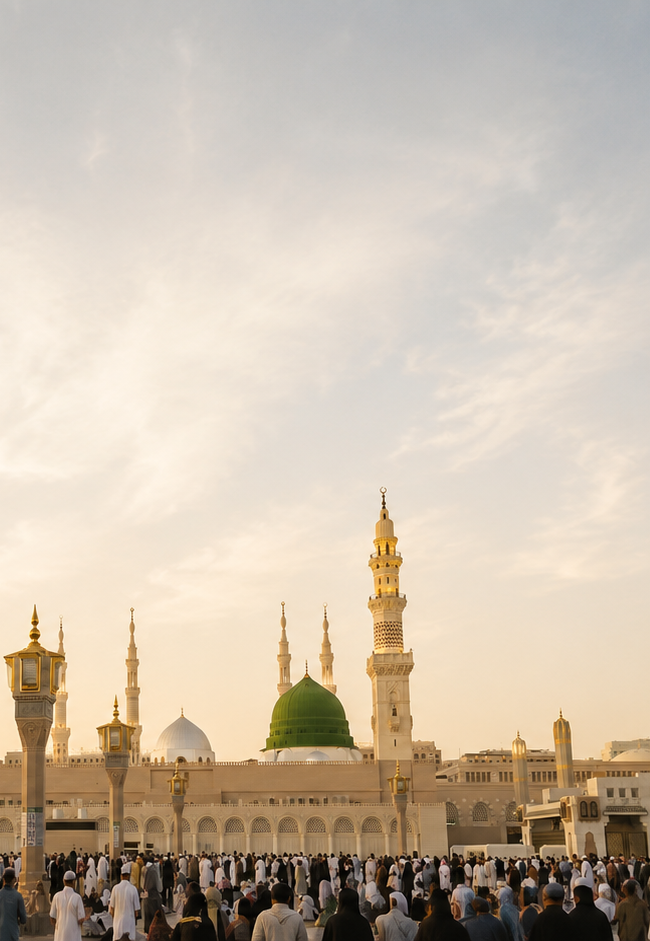
The places
The mountain above Makkah where the first verses of the Qur’an were revealed. The climb takes about an hour.
Iqra — the first word.
The cave where the Prophet ﷺ and Abu Bakr sheltered for three nights at the start of the Hijrah.
“Allah is with us.”
The plain of the Farewell Sermon, where every Hajj reaches its heart.
“Today I have perfected your religion.”
The first mosque in Islam. Two rak‘ah here carry the reward of an Umrah.
A mosque founded on taqwa.
Where the congregation turned from Jerusalem to the Kaaba in the middle of prayer.
A whole row, turning as one.
The mountain, the archers’ hill of Jabal al-Rumah, and the graves of Hamzah and the martyrs.
“Uhud loves us, and we love it.”
The line of the Trench and the small mosques that mark where the companions camped.
Salman’s idea that saved a city.
The Prophet’s mosque, the Rawdah, and the room where he rests beside Abu Bakr and Umar.
Between my house and my minbar.
The valley of the first battle, around 150 km from Madinah, with the resting place of its martyrs.
313 against a thousand.
At every stop
i.
Pre-departure sessions in Dhaka walk the Seerah in order, so every site lands in its place.
ii.
At each stop your scholar tells that chapter where it happened — who stood where, and why it mattered.
iii.
Time for du‘a, salawat and quiet at every site. Never rushed between buses.
iv.
Reading notes for each site, so families can retell the story long after the trip.
What’s included
Exact itinerary, hotels and prices are confirmed in writing for each departure.
Seerah Trip · 2024
We stood in Uhud while our scholar told the story, not lectured it. My teenage son still brings it up unprompted.
Farida Yasmin
Family of four, Madinah leg
Yes. Our Seerah journeys make time for Umrah in Makkah alongside the historical sites. Ask us about the balance of each itinerary.
A scholar travels with every group and leads each stop, alongside our ground team.
Yes — it is often what they remember most. Stops are paced for families and told as stories, not lectures.
Some sites, such as Jabal al-Nour and Uhud, involve walking or climbing. There is always an easier option at the foot of each site.
Because it changes how you hear the story for the rest of your life. Departures are limited, so we recommend asking early.